



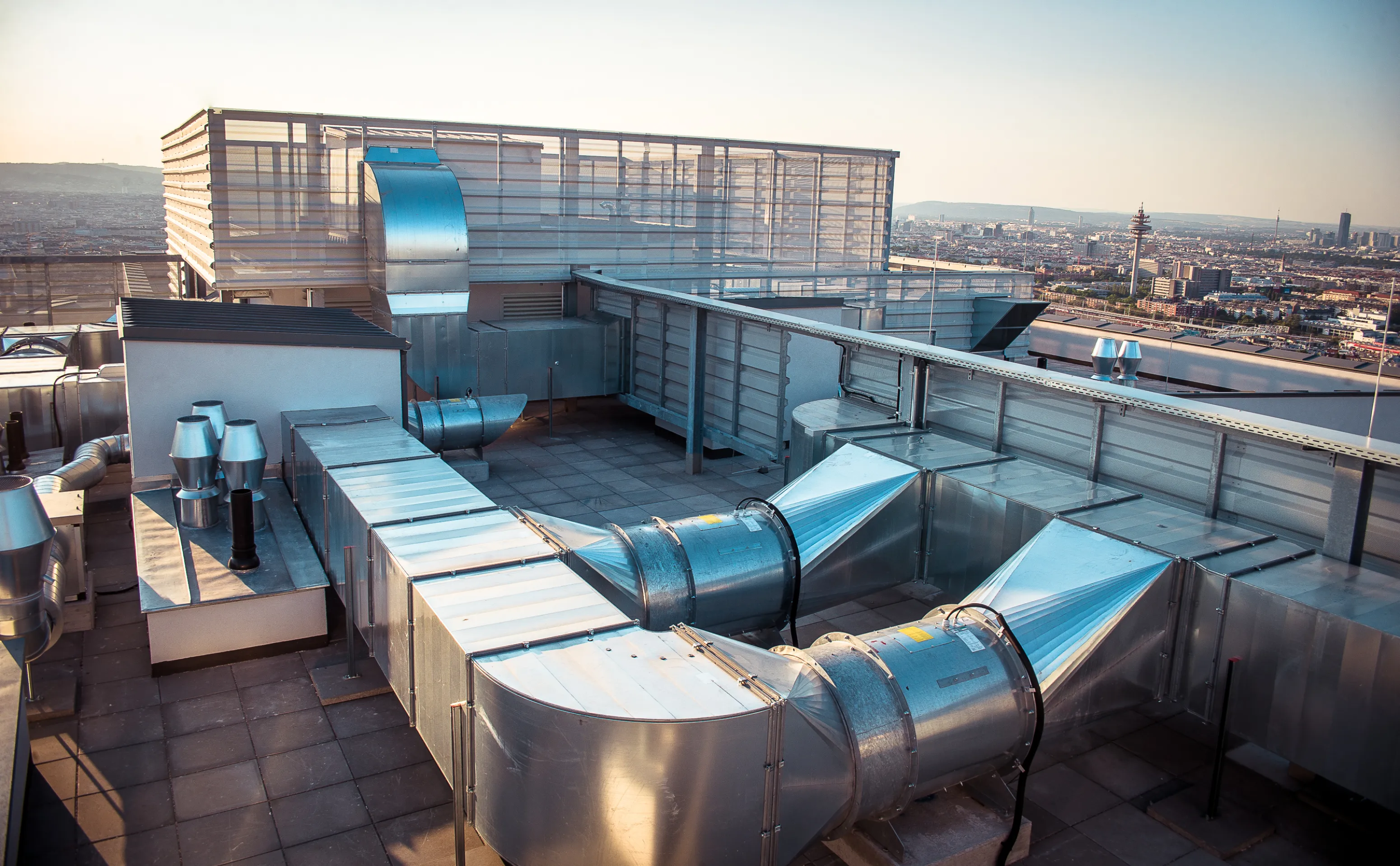
Stairwell pressurisation: the stay-in-place concept
The concept for residential buildings and small-scale office buildings: those affected by the fire escape via the smoke-free stairwell – everyone else stays safely in their flats.
The stay-in-place concept at a glance
The stay-in-place concept (Aufenthaltskonzept, often also called the stay-in-place principle) is one of the concepts for stairwell pressurisation systems under TRVB 112 S (Austrian technical guideline for fire protection). It assumes that only a few people are in immediate danger in a fire – for example the residents of the flat on fire. They escape via the stairwell, while everyone else stays safely in their flats.
Typical buildings: residential buildings with an escape level of up to 32 m and small-scale office buildings up to 22 m
Principle: at least 30 Pa overpressure in the stairwell; if the door to the fire area is open, air flows out at a speed of at least 1 m/s and holds back the smoke
Activation: via smoke detectors in the stairwell – the only concept permitted without a fire alarm system – or via a fire alarm system
Marking: pictogram “A” at the fire brigade access to the stairwell
The principle in simple terms
Imagine a residential building with six storeys. A fire breaks out in a flat on the third floor. The residents leave the flat and briefly open the door to the stairwell as they do so. At exactly that moment, smoke could get into the stairwell – and therefore into the only escape route for the entire building.
The pressurisation system prevents this: it blows fresh air into the stairwell and builds up a slight overpressure there. Through the open door, air flows from the stairwell into the flat – not the other way round. The smoke is pushed back and released to the outside via an air release opening, such as a window.
The neighbours do not have to leave their flats: each flat is separated from the fire by walls and doors, and the fire brigade can usually fight the fire from outside. That is why the system is designed for one open door. If all residents rushed into the stairwell at the same time, many doors would be open and the stairwell could fill with smoke. For this reason, there is no automatic building-wide alarm under the stay-in-place concept.
What happens in a fire
What the building needs
Self-closing doors to the stairwell and at the exit to the outside – ideally with free-swing door closers, which allow easy opening in everyday use and all close at the same time in a fire
Lifts with fire mode control to the exit level; the shaft of a firefighting lift is pressurised as well
A building in which the fire brigade can fight the fire effectively from outside
Manual call points at the exit and on the top landing, and a fire brigade control panel at the fire brigade access
Signage, including “Keep door closed when the pressurisation system is in operation” on the entrance door
Where the limits lie
The stay-in-place concept protects the escape in the first few minutes. If the fire brigade has to keep a door between the stairwell and the fire area permanently open while fighting the fire – for a fire hose, for instance – such a system can no longer reliably keep the stairwell free of smoke.
That is what the firefighting concept is for. In buildings where everyone is to leave when the alarm sounds, the evacuation alarm concept is used. Which concept applies is set out in the fire safety strategy or by the authorities.
What property managers and residents should keep in mind
Never wedge doors open: a stairwell door that is held open can render the system ineffective.
Keep the stairwell clear: items left there obstruct the escape route and can burn; the stairwell is checked monthly.
Self-inspections: the operator checks fans, pressure control, air release openings and signals every quarter and records this in the logbook.
Maintenance and inspection: annual maintenance and an inspection by an accredited inspection body at least every two years – we take care of the maintenance and attend the inspection.
After alterations: painting work on pressure sensors or work on air release openings? The function must be checked afterwards.
FAQ on the stay-in-place concept
Do I have to leave my flat if there is a fire in the building?
Under the stay-in-place concept, only if your own flat is affected or smoke gets in. All other flats are considered a safe area. Always follow the instructions of the fire brigade.
Why is there no alarm for the whole building?
Because the system is designed for only the door of the affected flat to be open. If everyone escaped at the same time, many doors would be open and the stairwell could fill with smoke.
Which buildings is the stay-in-place concept suitable for?
Under TRVB 112 S, typically residential buildings with an escape level of up to 32 m and small-scale office buildings up to 22 m. Put simply, the escape level is the height of the top storey floor above ground level. The decision is made in the fire safety strategy.
Does the stay-in-place concept require a fire alarm system?
No. It is the only concept in which the system may also be activated by its own smoke detectors. If a fire alarm system is installed, it activates the pressurisation system.
How strong is the overpressure in the stairwell?
At least 30 pascals relative to the fire area – low enough that every door can still be opened with a force of no more than 100 newtons, including by children and older people.
Who is the person responsible for the system?
A person appointed by the operator who is familiar with the system, usually the fire safety officer or the property management. They are notified of activations and faults and take care of self-inspections and maintenance.
Pressurisation for your residential building?
We design, install and maintain stairwell pressurisation systems to TRVB 112 S in Vienna and the surrounding area. Call us on +43 1 804 05 71.